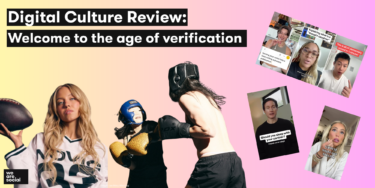
In an industry running on an entertain-or-die mindset, scrolling a feed often feels like stumbling through a funhouse: everything is either a meme, a bit or a reaction video blown out of proportion to elicit a response – be it snorts of laughter, or pure fury.
When everything is turned into a spectacle, we get skeptical. Back in June, cyberethnographer Ruby Justice Thelotcautionedthat we will begin to “doubt even the real, labeling it as artificial, simulated, fake”. Today, that skepticism has developed into mutually assured surveillance where we don’t just question, but start to canvass for what’s actually real.
New attention dynamics have pushed us to create spectacles on the internet.
Social is akin to a microcosm of a Netflix reality tv show, where we’re all fighting for screen time – attempting to win it by creating drama and controversy.
Hookbaiting remains a classic tactic: dangle a ridiculous statement, and let people come looking for the why.
Others choose to appeal not to curiosity, but to emotions via ragebaiting: knowingly doing something frustrating, inappropriate or offensive purely to provoke a reaction.
Over the past year or so, Sydney Sweeney has become its poster child, starring in some of the most controversial ads like American Eagle’s Great Jeans ad in 2025, where she was criticised for supporting regressive feminine ideals, and the infamous Novig ad this month where she’s been lambasted by female athletes for sexualising women in sports media.
Whether intentional or not, inciting such controversy has become part of the strategy. And it’s not just her.
But just because it works doesn’t mean it’s desirable. Establishing short-term notoriety to create spikes in visibility and engagement often comes at the expense of your reputation.
Surveillance culture is no longer thrust upon us, but becomes something we do to each other via content.
It’s not just performance being watched. The watching also becomes its own spectacle to behold.
The 2016 movie, Nerve, feels prescient in this regard. In the film, society is divided into players and watchers. Players perform the dares that the watchers want to see, while watchers indulge in the spectacle, produce content about the players, and impose punishment on those who break the game rules.
And let’s not be fooled by the inundation of chatter around the creator economy. Social is increasingly run by the watchers, who are the ones players are scrambling to pander to with their content.
And what may pass off as innocuous narration takes a more sinister turn when watchers find something they deem inappropriate.
They mete out punishment in the form of humiliation rituals that doxes and shames; what is deemed offensive or inappropriate is quickly made the subject of their next reaction video that is staged and shared communally, primed for crowd adjudication. And no venue is spared from the hawk-eyed public, whether it’s at the stands of a Coldplay concert, Wildflower Farms at upstate New York, or a random park bench.
In response to such canvassing, some have decided to quit the game: Ariana Grande has chosen to step back from the public eye entirely. After wrapping her Eternal Sunshine tour, the popstar cancelled her 2027 London stage debut in Sunday in the Park with George – though it may be worth noting that it ironically fuelled even more discussion online.
Others have chosen to build their case for their own credibility publicly, rather than wait to be cross-examined.
Within the creative industry, writers like Venkatesh Rao are publishing their prompt receipts, where they share the link to their ChatGPT transcripts so readers can pore over to understand exactly how they think. Substack has also created a new content series called Model Behaviour which delves into how public intellectuals work, including “a behind-the-scenes look at their creative process and explain whether and how they use these tools.”
It’s the same instinct our Q1 Digital Culture Review pointed to around verifiable proof, just turned up a register.
When everyone can be a narrator, what matters is whether you can earn belief.
In between surveillance and spectacle, there is a broader question to grapple with: who is still believed?
Especially amongst the younger generation, everything feels either edited or fake. According to Dazed Studio’s Parafaith report, 80% of youths often question the sources or truth of what they see online.
Cyberethnographer Ruby Justice Thelot posits that we will soon witness a resurgence of older modes of media like firsthand accounts or word-of-mouth – the kind of belief that travels through interpersonal relationships rather than screens.
We’re already seeing the first half of this play out.
The second half is showing up in who gets to keep our attention.
Creators who’ve spent years honing their craft, rather than manufacturing a moment, are the ones still earning it. Take for example, social media personality Alix Earle first went viral for her GRWM TikTok videos back in 2020. Since then, her continuous efforts to nurture her community has earned her recognition on the inaugural TIME100 Creators list in 2025, and landed her own Netflix show Earle Meets World. Another prime example would be Chinese-American freestyle skier Eileen Gu who has proven herself in the slopes, and is now seeing the payoffs online: her On Purpose podcast episode has been widely circulated, with the promotional post garnering over 540K likes.
In a sense, those who earn belief are the ones doing their own thing, and playing by their own rules rather than what is dictated by the platforms. Be it brand or creator, this is a reminder to double down on your convictions, rather than lose them amidst trendchasing and pandering to the flippant watchers who will change their minds again tomorrow.

 Thought Leadership